Yesterday (11 July) was the feast-day of Saint Benedict, the 6th-century Father of Western Monasticism and author of the Rule that bears his name. All religious traditions have an instinct for askesis, the process of training the body through a life of simple food and clothing, spiritual exercises and hardships. The ascetic life is entirely concentrated on God, through silence, work and prayer.
Benedict (born in 480) was absolutely part of this extreme tradition, at least at first. Living in a cave at the bottom of a deep chasm near Rome, he would seek to conquer physical temptation by hurling himself naked into brambles and thorns. He was sustained by only the most meagre rations, which were lowered to him by friends, in a basket suspended on a rope. He also attempted to live in a monastery, but was considered far too strict. The other monks tried to poison him, and he escaped.
He started a new monastery in Monte Casino, famous later as a site of extremely fierce fighting in World War II. Here he wrote a sensible and modest Rule, which he called A Guide for Beginners. In due time, it became the basis of the Rule of pretty much every western monastic Community of the past 1500 years.
The essential commitment of the monk or nun (known collectively as Religious) is to live in community in stability; that is to say, in this place, with these people for the rest of one’s life. It is a sort of marriage, a consecrated bond between the other brethren and the individual monk, to be ended only by death, a life in which each one works out their salvation with those whose lives God has called them to share. They have not chosen each other. As in the parish, it is God who chooses our neighbours, and it is our job to get on with things, and with each other, as best we may.
This second strand of transformation is called Conversion of Life. This commits the Religious to living without property, and without the intimate support of a spouse or partner, so that they might grow in holiness and become ever more Christ-like. It is a life lived absolutely on the edge, without analgesic or distraction; and those who think that this life is somehow ‘going for an easy option’ need to think again.
The third cord is obedience, by which is meant weaning oneself off the terrible and infantile craving to get one’s own way. Instead, Religious learn to be humbly open to God and to the members of their Community, especially the Abbot or Abbess.
At the heart of the monk’s life is the so-called Opus Dei or Work of God. This refers to the hallowing of time with prayer, filling every few hours of every day and night with the offering of worship, notably the singing of psalms. It’s what Anglicans call Mattins and Evensong, though sung on a rather more ambitious scale. This is the be-all and end-all of the monastic life. ‘Prefer nothing to the Work of God,’ thunders the Rule. And so nothing is more important than singing, and memorising scripture; chewing it over as a cow chews the cud; hour after hour, day after digestive day.
At other times, the members of the Community are studying, or working with their hands. For these occasions, they are taught that laborare est orare – to work is to pray, and vice-versa. Whether chopping logs or beating eggs, they should pray just as earnestly as if they were in church or in their cell. Working, praying; all is one: the Work of God.
I often find myself preaching about the monastic rule at weddings (and see my piece in this month’s Appleton Advertiser). As we noted above, there are many similarities between married and monastic life, despite the obvious differences. At their heart, each is a covenanted community – of two or twenty-two – whose life’s work is to be made ready for the kingdom of heaven through the relentlessly formative experience of sharing inescapably together the same slice of space and time.
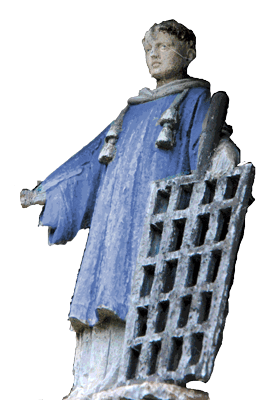
In other respects also, the so-called ‘ordinary lay person’, married or widowed or an unclaimed treasure, has much to learn from the Religious life. ‘My house shall be called a house of prayer,’ says the Lord in tonight’s second lesson (Luke 19.46). And rightly so. But, like the monk in his kitchen, or the nun in her garden, the degree of our Christian commitment is expressed not only by our life in church, nor tested only by the danger of our ending up on a griddle like St Laurence. It is greatly enhanced through our acquiring other habits of the monastery: the accompanying of the most menial tasks with prayer and meditation; the determination to hold fast to our whole community, even those individuals whom we find difficult; and the attempt to be obedient not only to our own desires and whims, but to the wise and considered voice of the Church, and to the pricking voice of our conscience, as the Spirit makes known to us the divine will, according to which we pray for the grace to be moulded, fashioned and trained.